
Often, yes. Under the California Public Records Act, a public record is any writing about the public’s business that a state or local agency prepares, owns, uses or retains, in any form. A prompt a county or city employee types into an AI tool about agency work, and the reply that comes back, fits those words. The California Supreme Court has already held that work messages in an employee’s personal account can be public records, so a personal AI account does not take them outside the Act.
What does the Act count as a public record?
Government Code section 7920.530 defines public records to include “any writing containing information relating to the conduct of the public’s business prepared, owned, used, or retained by any state or local agency regardless of physical form or characteristics.” Section 7920.545 defines a writing broadly: it starts with “any handwriting, typewriting, printing, photostating, photographing” and extends to electronic transmission and any record created that way, however it is stored.
Nothing in either section turns on the tool. A typed prompt and the reply it gets are recorded communications, so the questions are the same ones the Act asks of an email: is it about the public’s business, and does the agency prepare, own, use or retain it?
Does it matter that the chat sits in a personal account?
Not by itself. In City of San Jose v. Superior Court (March 2, 2017), the California Supreme Court held unanimously that emails and texts about public business on employees’ personal accounts and phones may be subject to disclosure, and that public records “do not lose [their public] status because they are located in an employee’s personal account” (California Supreme Court opinion).
The court set two limits that carry over to AI use:
- A writing must “relate in some substantive way to the conduct of the public’s business.” A personal question with a passing mention of work generally is not a public record.
- The agency’s search “need only be reasonably calculated to locate responsive documents.” Employees may search their own accounts, and an employee who withholds material as personal must give facts showing it is not a public record.
The court also pointed agencies to a simpler path: require staff to do agency work in agency accounts, so the records are already where the agency can search them.
As far as we can find, no published California decision has yet ruled on AI chat history specifically. The statute’s words and the San Jose reasoning are what a court would start from.
How fast does an agency have to answer?
Section 7922.535 gives the agency 10 days from receipt to decide whether the request seeks disclosable records and to say so, with reasons. In unusual circumstances the head of the agency can extend that by written notice, and the notice “shall not specify a date that would result in an extension for more than 14 days.”
That clock runs the same whether the records are in an email system the agency runs or in AI accounts spread across departments.
What should a county or city do now?
- Decide where AI work happens. Name the AI tools staff may use for agency work and the accounts they use them in, following the court’s own suggestion in San Jose.
- Keep the record where you can search it. If prompts and replies live only in each vendor’s account, every request becomes a hunt across departments and personal logins. A record your agency holds is one search.
- Write AI into your records request process. Tell your records staff and counsel where AI records live and who searches them, before the first request names ChatGPT.
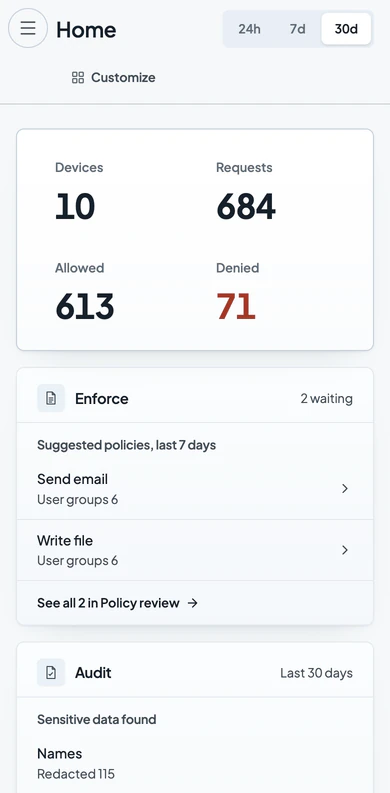
Verillian keeps a record of AI requests from your staff devices, on your agency’s own servers, ready to search and export when a records request arrives. See how clerks use it.