Transparency
The public can ask for staff AI chats, kept in accounts you don’t hold.
Blocking AI hasn’t worked, and waiting isn’t safe either. Here’s what it takes.
A public agency answers to residents for each of these duties, and staff use of AI strains every one of them.
The public can ask for staff AI chats, kept in accounts you don’t hold.
AI drafts read like staff work, so you can’t tell which were checked.
Council can ask how staff use AI, and much of it began before any review.
AI can carry bias from its data into who gets served, inspected or hired.
Resident data that staff paste into a free AI tool leaves your control.
An AI tool linked to your files can follow orders hidden in a document.
No. When an agency blocks AI, the work moves somewhere it can’t see.
Agencies that use AI with a person in charge are already measuring the gains in shorter waits for residents and hours back for staff.
Staff in a year-long pilot reported saving about 95 minutes a day
The 175 staff, from 14 state agencies, used an AI assistant at work for a year on their administrative tasks.
AI redirected an estimated 33% of one county’s non‑emergency calls
The AI attendant sent those calls to the right office or an online form, so dispatchers could stay on emergencies.
Average permit review time fell by more than half in one city’s sample
The city checked 19 residential plans with AI before staff reviewed them, and the average fell from 73 days to 32.5.
Time caseworkers spent entering case notes fell by 51% in a 40‑person pilot
Caseworkers reported the saving after using an AI note tool, with clients’ consent, and staff reviewed every note.
Both carry risk. Federal AI policy asks agencies to adopt AI faster, and to stop any use whose risks they can’t mitigate.
So the real risk is AI your agency can’t see, control or account for.
Safe staff use of AI takes safeguards that meet every one of these technical requirements, grounded in NIST guidance, led by the AI RMF 1.0.
Controls must be deterministic, so one request under one policy gets one decision.
The record must capture the full turn, from the prompt and tool calls to the reply.
Each AI action must tie to the person and the device behind it.
Identifiers a policy flags must be redacted before the request leaves the agency’s control.
Each team must reach only the AI tools and actions its work needs.
Staff must not be able to disable the controls or work around them.
If the controls go down, AI requests must be denied, never waved through.
An agent’s tool calls, including what data it reaches, must be checked before they run.
The record must stay under the agency’s control and keys, never reused by a vendor.
Each record must be tamper-evident, so any change to it shows.
Records must follow the agency’s retention schedule and be found by person and date.
Security must be able to contain one person, one device or every device.
One policy must govern local models and the models in a provider’s cloud.
Each kind of tool below does part of the job well. Here is what each does, where it sits, and how it measures against the requirements above.
Each row’s marks follow the thirteen requirements above, in this order, graded from vendors’ public documents.
Send apps’ model requests through one point that sets access by written rule and logs each one.
Biggest gap. It sees only what apps send, so chat sites and personal accounts go around it.
Check each agent tool call against written rules before it reaches the tool, often self-hosted.
Biggest gap. It sees the agent’s tool call, but its record misses the prompt and the reply.
Route device traffic through the vendor’s cloud edge, tie it to the signed-in person and set access per group.
Biggest gap. Its network products check after requests leave the agency, and keep records in its cloud.
Spot sensitive data in a prompt, paste or upload by fixed rules, then block it or warn the person.
Biggest gap. Its record holds matches, not the full turn, and covers local models only in part.
Watch AI use on the device, redact in the browser before a prompt is sent, and block some agents’ tool calls.
Biggest gap. Coverage depends on the surface, and a browser product covers only the browser.
Lock each coding agent’s settings so a written rule checks every tool call, and staff can’t override them.
Biggest gap. Its policy binds only that agent, leaving other agents and local models outside.
A screening model scores each prompt and reply, and catches the injections and jailbreaks fixed rules miss.
Biggest gap. Its main check is a model’s score, and it covers only apps that call it.
Give admins full transcripts, holds and export by person and date for the provider’s own product.
Biggest gap. It covers only its own product, and checks after the request leaves the agency.
Run models in the agency’s own cloud account, where identity policy denies unapproved models by rule.
Biggest gap. It governs only the models in that account, not chat sites or staff devices.
Classify sensitive data, apply rule-based DLP, and keep AI prompts and replies in the agency’s tenant.
Biggest gap. It covers its own apps best, and by default passes requests when checks can’t run.
Find the models, agents and tool servers in cloud accounts, and rank the risky permissions to fix.
Biggest gap. It maps the AI in your cloud accounts, but it decides no request.
Find the AI tools and accounts nobody approved, and coach staff as they work.
Biggest gap. It coaches staff on AI use, but its documents don’t say what decides a request.
Inventory the agents on agent platforms, revoke access they don’t need, and block a tool call where the platform allows.
Biggest gap. It covers the agents on the platforms it connects to, and no others.
Register each AI system with its risk assessment, its approval and the evidence auditors ask for.
Biggest gap. It records what is approved, and decides no request without an added module.
Collect the logs other tools send, so security can search by person and time and isolate a device.
Biggest gap. Logs arrive after the request ran, and hold the full turn only if sent.
AI red teaming and model scanning test models and AI apps before launch and on a schedule. They aren’t built to govern staff use, so they aren’t graded here.
Each kind does part of this well, and buying several together covers more. In the public documents we read, no product or set of products meets all thirteen requirements in one place.
Verillian governs the AI your people already use, and it keeps every captured interaction in a tamper-evident record on your own servers.
Written rules, not an AI model, decide each request, the same way each time.
Each captured turn keeps the prompt, its tool calls and the reply in one record.
Each record names the person, the device and the time.
The AI provider sees placeholders where flagged identifiers were.
Policies are set per group of staff, such as caseworkers or planners.
The controls hold on every enrolled device, and staff have no way around them.
A request the rules can’t apply doesn’t go, even with your server down.
A denied call to an agent tool your policy governs doesn’t run.
Records stay under your agency’s keys, and Verillian never receives them.
Any change to a stored entry shows, so the record holds up in an audit.
Find any captured record by person and date, ready to export.
Security can contain one person or device, or use the kill switch for all.
One policy and record cover models on your hardware and in the cloud.
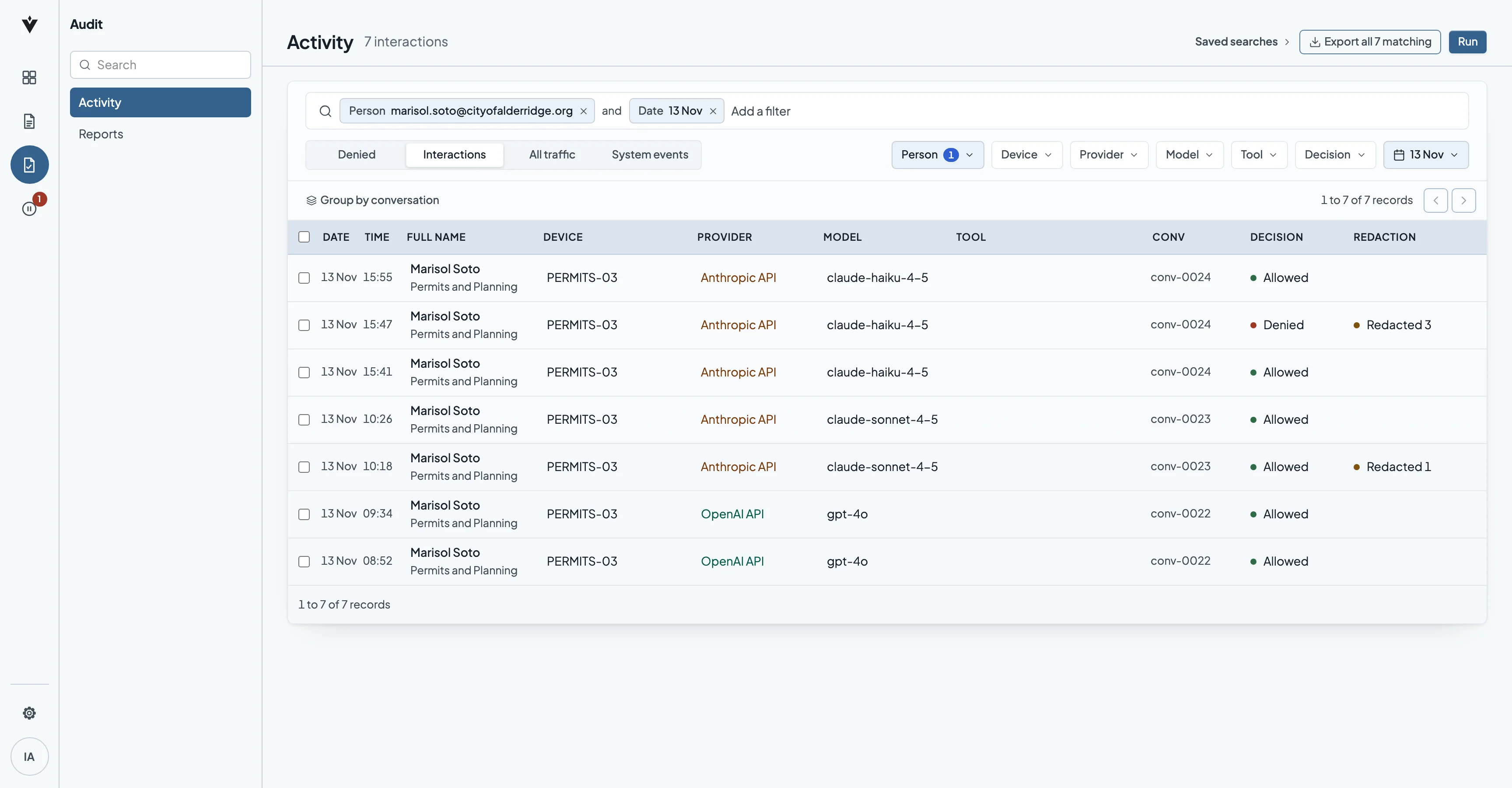
A records officer’s search for one staff member on one day lists every captured record. That helps you meet part of NIST’s guidance for generative AI.
IT can read the Security Packet before the demo.
See it on your own policy.